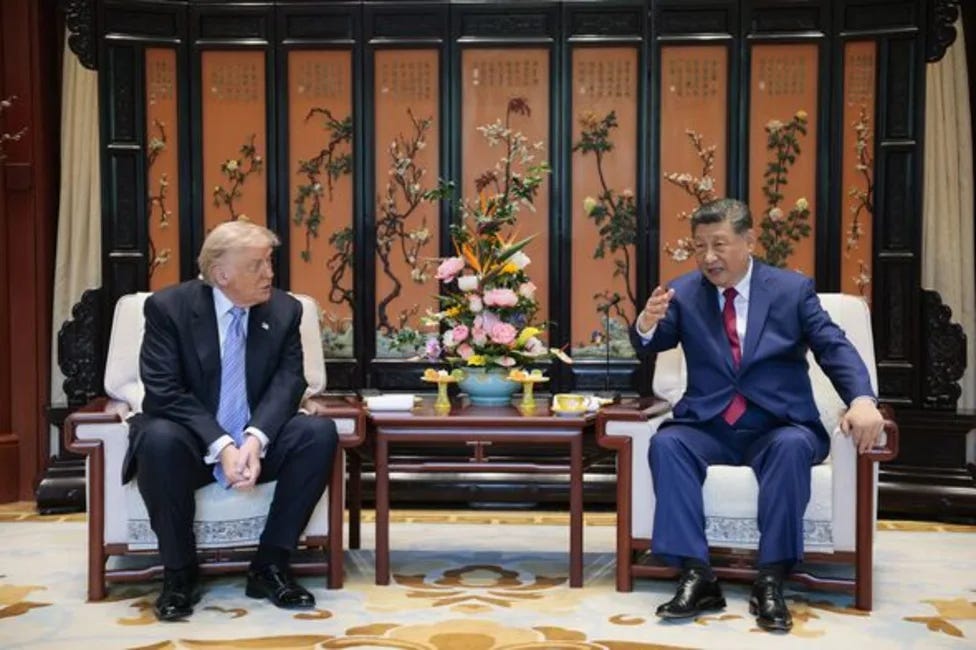
A new global disorder is taking shape. Few see it yet, but the leading indicators are already coming into view. Historians will likely judge the Xi–Trump summit a turning point on the order of Yalta — alike in kind, yet worse in consequence. Both summits had to manage uncomfortable trade-offs between divergent military realities, national interests, and values. In both cases, the democracies assessed they had very little room for maneuver because the facts on the ground had shifted radically against their position. At Yalta, the West conceded Eastern Europe from comparative strength: it held rough military parity on the day of Germany’s surrender and acquiesced to Russia’s control of Poland, because dislodging it by force would prolong the war for years while demobilization at home and the unfinished war against Japan left no political room to do otherwise. At Beijing, Washington conceded Taiwan and its Indopacific alliances from weakness, trading away decisive cards still in hand to buy short-term relief from the Iran folly. Relief, it must be noted, that NSD confidentially assesses will not arrive.
From the 1970s energy crisis until the Trump-initiated energy crisis of today, America has actively then passively provided China with a global security blanket within which China, not NATO, was the ultimate free rider. Seizing this opportunity, China has invested untold riches in generative spending at home and abroad, while America has deepened its ever growing debt in ill-advised military adventurism driven by extensive strategic malpractice.1 The cost of losing the forever wars, combined with vast mismanagement of the US economy and military, has triggered a sharp decline in American power and rapidly intensifying waves of socio-economic turmoil at home as the polity slides into authoritarianism, triggered by the backlash to all these failures.
Russia and America are busy committing sovericide. The EU is an unconscious powerhouse - it has yet to develop an assertive foreign policy. The last power standing is China. The PRC is on the verge of being the world’s supreme power simply by not interfering as the others self destruct. In Asia, is it already supreme.
[Sovericide - is the deliberate, internally driven destruction of a sovereign state by its own governing executive.2The National Security Desk forecasts that the near term horizon of American sovericide will likely include a continuation and/or deepening of these extant features of destabilization: a second attempted coup, deepening erosion of the separation of powers (constitution), trade wars, supply-chain disruption, debt explosion, refusal to raise revenue, de-dollarization, repudiation of allies, embrace of enemies, fragmentation of federal authority, are all overloading a rapidly deteriorating governance apparatus across multiple axes simultaneously.]
Picking the exact moment of Chinese peak power is irrelevant by comparison to the direction of travel down an observably steepening slope. Given the way America is doubling down on exorbitantly costly unforced errors, the most recent of which is the utter own-goal in Iran, with national debt peaking past GDP, inequality surpassing the gilded era, and unparalleled domestic divisions, China has likely already arrived. Understanding the implications of this change in the global order is vital.
The Forge
The new world disorder is driven by two primary vectors. First, the erosion of US legitimacy, capacity, and will - resulting in abandonment of the EU/NATO and the democracies of Asia (with whom the US has NATO-like treaty security obligations). Second, rising Chinese confidence that its now openly belligerent foreign policies will not be challenged by a weakened and departing US. Accordingly, the Chinese judge that their economic and military power is far too overwhelming for disparate middle powers and small states to individually or even collectively resist. The National Security desk characterizes these two powerful forces as “The Forge”. Chinese power is the hammer and American weakness the anvil.3
Counters to this proposition include the fact that China’s economy is shaky, its internal security is never a given, and its military remains untested and has historically shown signs of significant corruption - something that has prompted purges - including recently. While the PLA can throw a mean parade, Xi is purging the military in an attempt to ensure that it wont collapse like a paper tiger the way the “mighty Red Army” did a week into its 3 day war of conquest against Ukraine. America has barely stopped fighting since 1945. China’s most recent engagement was against Vietnam in 1979 and they made quick work of the PLA.
The Chinese military of today is a completely different animal to what it was just a decade ago. Following the shock of the first Gulf War, China closely emulated the US military, stealing its blueprints and mass producing platforms that appear similar.4 Analysts question whether their jet engines and stealth coatings (etc) are 1:1 with US capabilities, but at a certain point numerical superiority of slightly less capable copies overwhelms any quality deficit.5
Look familiar?
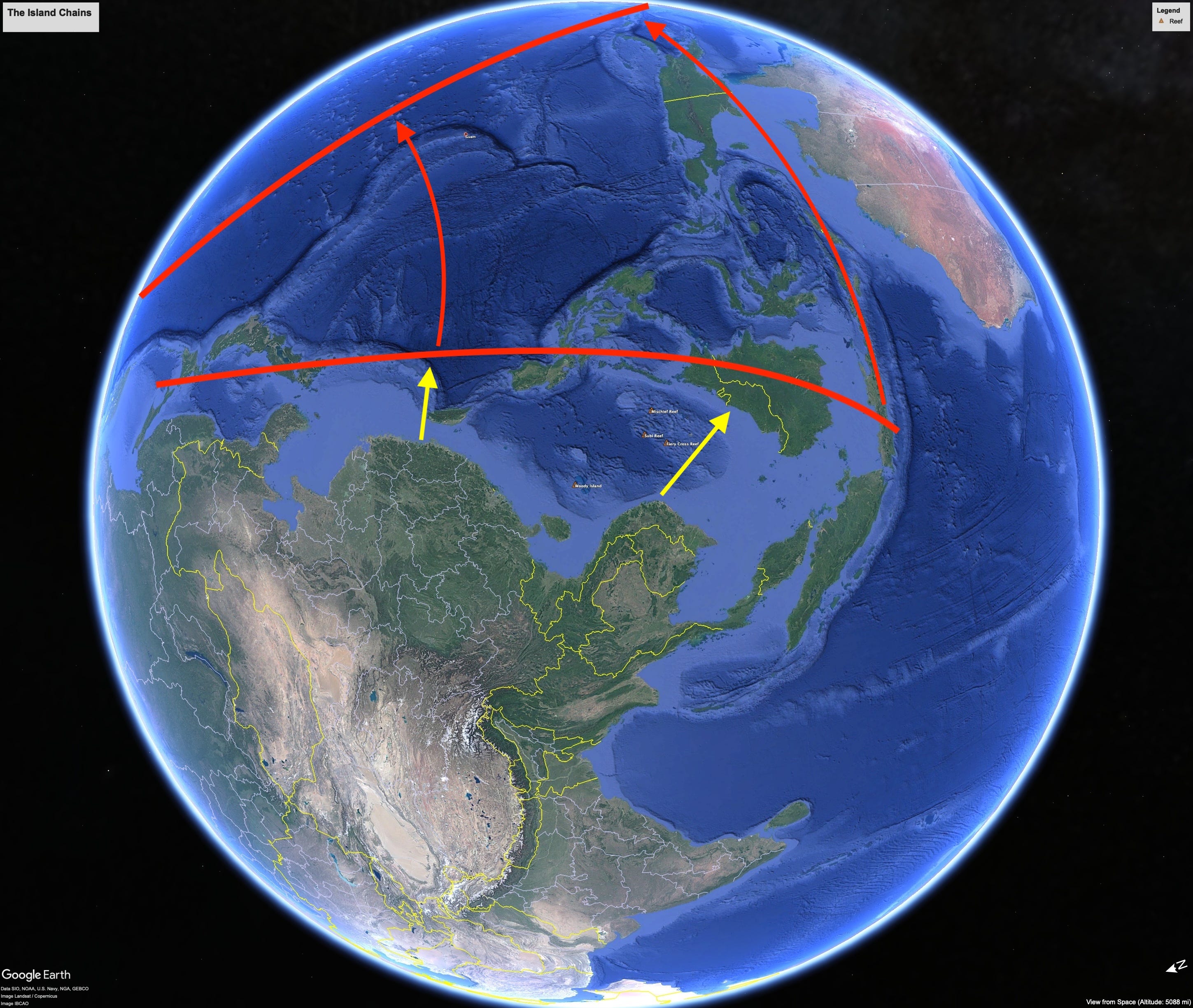
The counters are real and should not be dismissed out of hand. Yet compared to American sovericide, and Russian collapse, China has a set of distinct advantages. For twenty solid years the PLA has been investing in platforms and vast missile stocks in conditions of complete peace provided by the US. It has achieved comprehensive missile saturation of the South China Sea. The US does not dare send a capital ship into what it now calls the “Weapons Engagement Zone”(WEZ). In other words, west or north of the Japanese, Philippines or Indonesian islands.
The WEZ (Weapons Engagement Zone)
China also enjoys the unique advantage of interior lines - meaning America has to come from a world away to fight and return to that world to rearm. Chinas military industrial mass is in the area of operations and has never stopped building. It has never used a weapon in anger. America has never stopped using up its weapons stocks that it has irresponsibly allowed to take years to replenish.
While its global position might be debated, Xi knows China has easily surpassed America as the ruler of Asia. Trump has no clue. So long as he makes money, he does not care about the finer points of statecraft, the global order, or the future freedom of the American people or our traditional allies. The hammer and anvil are therefore very real and deeply threatening to all those countries America used to proudly call an ally. However, all is not lost for the Asian democracies. China is bound to a profound geographic reality: mass is an entitlement that only functions if its jugular remains un-severed.
Qui tacet consentire videtur
Xi reduced Trump to a vassal the moment he told him, to his face, in public, and free of rebuttal, that
“The era where one power dictates the global order is passing….’Great changes unseen in a century’ are accelerating, [requiring the two great powers to] overcome the so-called ‘Thucydides Trap’ and create a new paradigm of major-country relations”
In other words, the US has no choice but to acquiesce to China’s power. If that declaration of China’s new world order was insufficient to make an impression on his interlocutor, Xi added a direct threat to drive his point home:
“The Taiwan question is the most important issue in China-U.S. relations... Otherwise, the two countries will have clashes and even conflicts, putting the entire relationship in great jeopardy”.6
The entire summit and the wider historical moment are summarized by these two unchallenged quotes. Masters of the veiled reference, the Chinese delegation watched as the hapless Americans appeared to completely fail to comprehend the message due to its intellectual framing. Trump questioned on the plane home tried to pass this off as a criticism of Biden responding that “President Xi congratulated me on so many tremendous successes in such a short period of time.” No sensible person anywhere believes this empty propaganda. Whether he understood the ‘Thucydides Trap’ or not is irrelevant; the rest of the world certainly did. Qui tacet consentire videtur. They watched Trump’s dead silence—an inversion of Reagan at the Berlin Wall. That silence was all Xi needed. Give him Taiwan, and he will take all of Asia.
Any other American President would have used that moment to reassert the standard ‘One China policy’ framework: acknowledging Beijing’s claim without endorsing it, taking no position on Taiwan’s final status, and insisting that any resolution be peaceful and reached with the consent of Taiwan’s people.
Silence is assent. Trump was too busy begging Xi to alleviate the fallout of his own short-term foreign policy failure in Iran to stop and observe what was happening to him in Beijing. Lacking principle or vision, his silence offered up Taiwan - one of Asia’s thriving democratic, technological, and economic powerhouses - on a platter to its aggressor. Just as he completely ignored every adviser who warned that the Iran conflict would close the Strait of Hormuz, sending inflation spiraling and the global economy into a tailspin. Instead, he spent the Taiwan chip trying to buy his way out of his own strategic stupidity. It never crossed his mind that an adversary would have no interest in saving him. Napoleon’s dictum is apt here. “Never interrupt your enemy when he is making a mistake.” Xi was content to simply sit back and watch America tighten the very noose it had braided, tied, and willingly stepped into.
“Great Changes”
Xi insists America must accede to China’s power due to ‘great changes unseen in a century’. Xi is referring to a series of dramatic shifts that the National Security Desk has identified in our writing over the past 5 years. China's rise, and America and Russia's sovericide. China’s rise has been accelerated by the idiocy of its rivals. The only leader that has engaged in worse strategic malpractice than the sovericide of the United States, is Trump’s hero and role model - Vladimir Putin. Russia is 1,564 days into its three-day war against Ukraine — a war that has cost Russia some 1.2 million casualties, gutted its budget, idled its oil exports, and left its strategic bombers burning on their runways after being attacked by toys, driving the country toward imminent collapse.7
As the US and Russia impose pending disasters on themselves, only two major powers remain: the European Union and China. Unlike all the others, the EU has never perused expansionist goals. It is busy deepening its democratic traditions, building its economy and technological base, protecting its community, and most recently, grappling with the hammer and the anvil.8
That leaves China, whose leader opened this summit by telling the President of the United States, to his face and unchallenged, that the American century was over. With the EU in its own lane and neither Russia nor America able to come back from the point of no return, China wins the coming decades by default — at least until it, too, makes the hubris-driven grand mistakes of late empire at some far off point in time.
But default is not destiny. Ukraine and Iran have already sketched another future: one in which the “small countries” band together and teach the “big country” a lesson.
YALTA
At Yalta, the US and UK reluctantly traded values for interests. In time, that trade would be understood as a mistake, but a necessary one. Their powers were divided fighting Germany and Japan. Whereas the USSR was only fighting Germany - which to its credit it did on a scale unprecedented in history. Nevertheless, that fight depended on an abundant flow of Western armaments, further draining Western capacity to later resist Stalin. By the time they got to Yalta, the democracies judged they could not politically afford to continue the war against the Soviet dictator (who had been Hitler’s ally until mid 1941). Despite near-parity in the balance of forces along the east-west divide on VE-Day, there were powerful circumstances that prohibited the allies from playing hard ball with Stalin.
At the moment of Germany’s surrender in May 1945, the Western Allies fielded roughly 4.5 million troops across 91 divisions, ~17,000 tanks, ~63,000 artillery pieces, and ~28,000 combat aircraft.
While Stalin’s forces in Europe numbered approximately 6 million troops across hundreds of divisions, ~14,000–15,000 tanks, over 100,000 guns and mortars, and ~14,000–15,000 combat aircraft
— the West held a 2:1 edge in the air and rough parity in armor, but faced a crushing Soviet advantage in artillery and a significant infantry overmatch, with Soviet divisions outnumbering Allied ones nearly 3:1 in the Central European theater. .9
The democracies were under enormous pressures that did not concern the Soviet ruler. Demands for immediate and total demobilization were sweeping Britain, America and allied societies. FDR and Churchill had to balance that public passion against the harsh reality that the pacification of Japan was still a terrifying prospect. At Yalta, nuclear weapons were unproven in combat and could not be relied upon as the game changer they would become (with respect to ending the war with Japan and as an off-set to massive Soviet numerical superiority in Europe following western demobilization.) Consequently, Moscow emerged as the default dominant power of Europe.10
Sacrificed Values
V-E Day was bittersweet for Churchill. It was cleaved from the moral victory befitting Britain’s sacrifices. For Britain, WWII was ostensibly over a guarantee of security to Poland. Churchill was humiliated that the British Empire was wasted in a long, initially lonely, noble fight, (that turned into one of survival), only to concede the exchange of tyranny over the blighted people of Poland from the Nazis to the Soviets at Yalta.11
Beijing
In Beijing in 2026, a similar fait accompli lay in wait, mostly of America’s own making. Although not as direct or immediate as the pressures at Yalta, the shift in the military balance of power had become impossible for Washington to ignore. Over the past 30 years, the geopolitical center of gravity has been gradually shifting west from Hawaii as a string of failures in American statecraft failed to shape China’s rise while it still could. Trump, Biden, Obama, GW Bush and Clinton, all have played their part in that history.
Initially, America was only too keen to support China’s rise, (not completely unreasonably) hoping that capitalism would make democracy inevitable at some point in China’s near future. The collapse of the Soviet Union only encouraged this thinking. This historic triumph birthed a profound institutional blindness in Washington—an ideological complacency that treated Western primacy as a permanent law of nature rather than a temporary geopolitical consequence. For a generation, the American national security apparatus operated under the delusion that history had ended, transforming statecraft into a passive exercise in market expansion. By the time the shock of 9/11 shattered that complacency, Washington merely traded one form of tunnel vision for another, swapping the romantic illusion of inevitable global democratization for the strategic exhaustion of the forever wars.
The Chinese Communist Party (CCP) cheated history’s noose by inverting the Russia mistake. Economic freedom without political freedom was the key to their rapid success enabled by America providing access to global supply chains, finance and markets, while posing no threat to the mainland via acceptance of the One China policy.12 Under these extraordinarily beneficial conditions, China’s rise was underwritten by the US. It was not until China had consolidated its economic and military power, that it began to bite the hands that fed it. Rapidly rising from a century of humiliation will do that to a power that historically had viewed itself as superior to all others. Overtime, ‘peaceful rise’ metamorphosed into ‘wolf warrior’ belligerency. Now it has graduated to issuing direct, public, fait accomplis to a country that was once considered the “leader of the free world”.
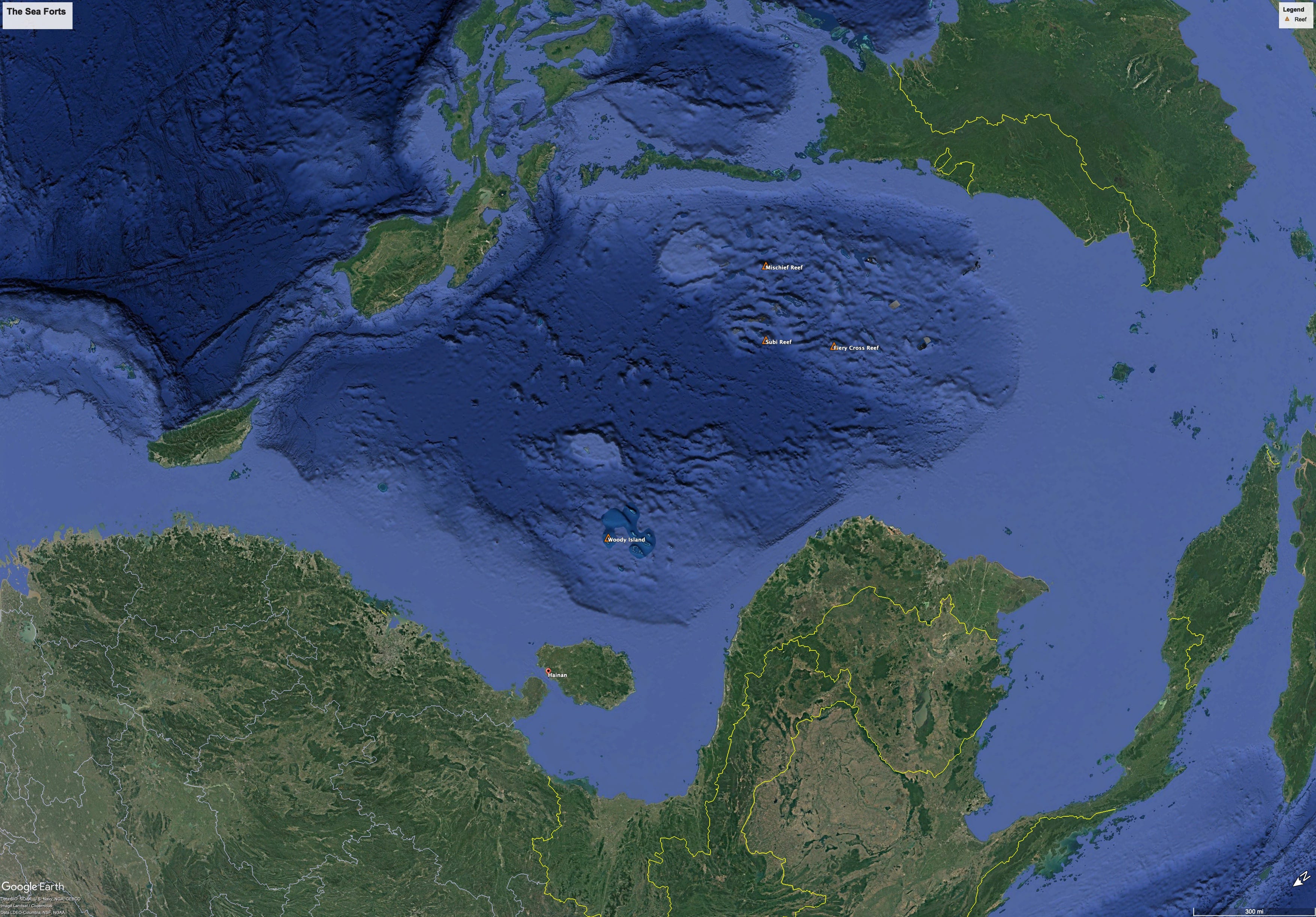
In the 2000s, America’s primary military mistake was allowing the Chinese invasion and occupation of what have become sea forts in the South China Sea (SCS).13 Of roughly two dozen Chinese‑held outposts, four have been built out into full‑scale military strongholds with long runways, hardened fighter and bomber shelters, extensive radar and communications arrays, and layered anti‑ship and surface‑to‑air missile batteries. Together with Hainan Island, Fiery Cross Reef, Subi Reef, Mischief Reef, and Woody Island serve as forward bastions projecting heavy combat power far beyond the first island chain deep into the Pacific
The Sea Forts
The Sea Forts Extend Chinas Long Range WEZ deep into the Pacific
This was possible because for two decades America was too busy diverting its strategic bandwidth and Indopacific forces to the Middle East and Africa. A mistake it is currently repeating. Over this same period, America made a series of self-reinforcing strategic blunders, each one worse than the last. Usama bin Laden was history’s greatest gift to the CCP:
We, alongside the mujahedeen, bled Russia for 10 years until it went bankrupt and was forced to withdraw in defeat, using guerrilla warfare and the war of attrition to fight tyrannical superpowers. We are continuing this policy in bleeding America to the point of bankruptcy. All that we have to do is to send two mujahedeen to the furthest point east to raise a piece of cloth on which is written al Qaeda, in order to make generals race there to cause America to suffer human, economic and political losses without their achieving anything of note other than some benefits for their private corporations.
A superpower ceases to be a superpower if it cannot do two things at once. The pursuit of small bands of men with AK-47s, who were next to impossible to tell apart from the publics within which they moved so effortlessly, “as a fish swims in the sea” to quote Mao, On Guerrilla Warfare (1937) - triggered America to spend lavishly on spiraling sunk costs - human and material - using money it borrowed from peaceful and prosperous China.
The US all but forgot that China existed, let alone took any action to curb China’s increasing belligerency. The best example of this was US forces in the Pacific being sent to bolster actions in the Middle East rather than being used for their purpose to deter China. This happened throughout the 2020s and is still happening to this day. In 2025 and 2026, the Pentagon stripped critical AN/TPY-2 radar components, three Patriot batteries, and more than 100 advanced THAAD interceptors directly from South Korea—burning through over half of America’s total global missile defense stockpile to plug tactical gaps in the Middle East at the direct expense of Indopacific deterrence.14
As China quietly invested in its future, America’s forever wars yielded strategic failure across every available metric. America squandered $8 trillion in deficit spending, on wars of meritless strategic and economic weight among people who would never share its values.15 Indeed, their enmity would only multiply with time and tactical blunders (for example, Abu Ghraib and any wedding in the Kush). The American war in Iraq destabilized the wider Middle East in ways the United States is still mismanaging today. In Afghanistan, the Taliban returned to power almost twenty years to the day of the fall of Kabul.
The true opportunity cost of this folly was paid in Asia. The economic and demographic ledgers expose the profound scale of Washington’s miscalculation: total U.S. trade with Iraq and Afghanistan in 2024 was less than one five-thousandth of one percent (1/5,000 of 1%) of its trade with the Asian democracies. Furthermore, the combined population of the Middle Eastern theaters is barely one-tenth the size of America's democratic partners in the Indopacific—including ASEAN, Japan, South Korea, Australia, and Taiwan. Washington ignored a demographic behemoth of nearly one billion people (that represents 65 percent of the Chinese population), generates $1.41 trillion in two-way trade, supports 5.2 million American jobs, and serves as the undisputed global epicenter of technology, modern manufacturing, and consumer demand. A powerhouse bound to the U.S. by critical treaty alliances and democratic values.16
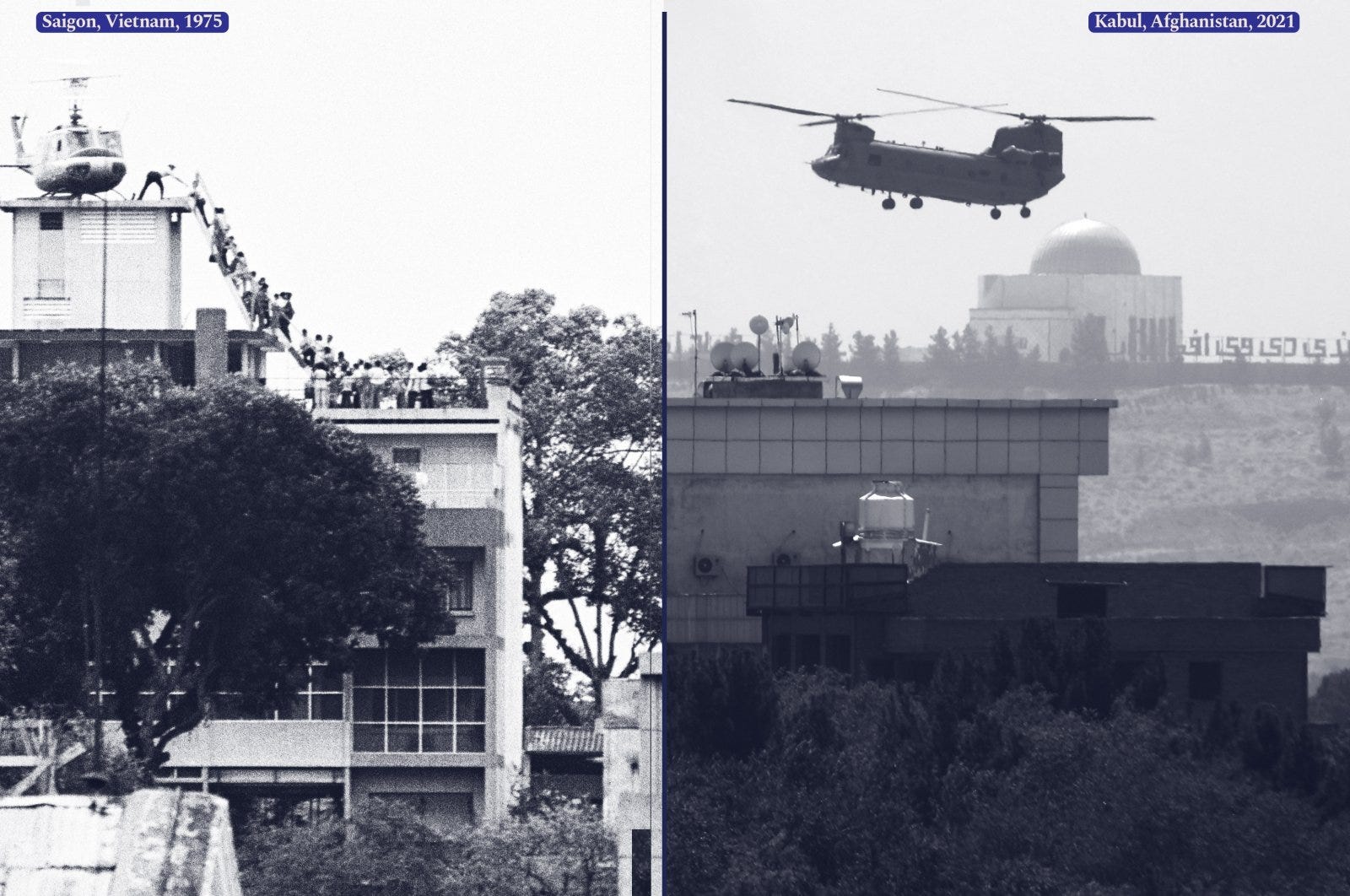
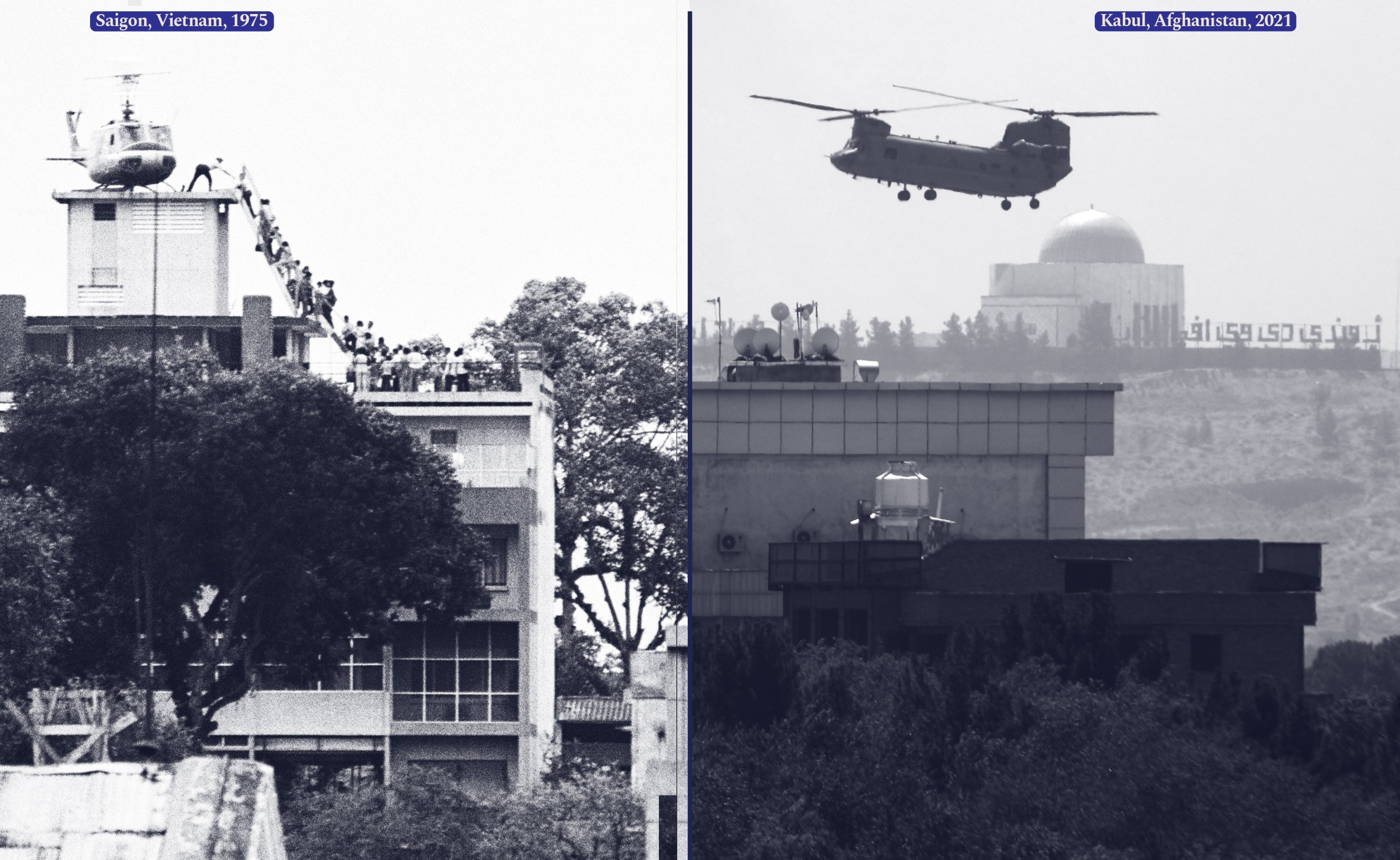
Meanwhile, at home, more than 2 million American veterans had returned from the hateful sands wondering “what was it all for?” They were rewarded with a promise that their sacrifices would not be in vain. That America would end the war with honor and not with a humiliating helicopter-on-the-embassy-roof scene that scarred an earlier generation with its message of tragic futility. Hours later, exactly that happened, almost twenty years to the day after they were promised their gift to the people of the graveyard of empires would be enduring freedom.
That turmoil came on the heels of the crashed US economy that had been stripped of the regulatory protections put in place after the Great Depression. The political class appeared as clueless about that as it had been over its mismanagement of the forever wars. Fury at the system gave a gameshow host an unlikely electoral opportunity to embody the public’s middle finger to the establishment. A global pandemic then sent everyone into angry and fearful isolation. Unsurprisingly, none of this ended well. Except for China’s unmolested accumulation of astonishing military power.
Prisoners load pandemic victims into scores of trucks. Headlines from the 2008 Crisis.
America has lost the Iran War
The war in Iran is the capstone of this history of incompetence.17 Much like Putin’s miscalculations in Ukraine, Trump entered this conflict blinded by hubris, only to make the adversary stronger. Far from forcing regime change, Trump’s war effectively rescued a fractured autocracy. By converting a domestic political crisis into an existential war for survival, Tehran successfully hijacked nationalist sentiment to neutralize the internal critics who had threatened its rule since 2009. The historic domestic protest movement was utterly crushed under the weight of wartime mobilization, trading a potential democratic awakening for a hardened, unchallenged dictatorship. Today, this re-energized regime controls its highly enriched uranium, commands absolute domestic submission, and maintains an unassailable stranglehold on the world’s most critical economic choke point—leaving a hostile power to dictate American inflation six months ahead of a volatile domestic election where the unpopularity of the regime in Washington is finding new unprecedented depths.
Early Pentagon claims of a “capital V-Victory” including the destruction of 90% of Iranian weapons systems were categorically proven wrong by the National Security Desk. Our assessment was later validated by Pentagon leaks and congressional testimony. What losses Iran did sustain (US DOD and IC estimate ~20-30% of stocks) have been rapidly replenished during the endless cease fire. America has found a second WEZ it dares not enter.
Yet again, US forces in the Indopacific have been surged to the Middle East to wither away in a fruitless misapplication of power that only furthers China’s rise.
As of today’s date, the Iran war has drawn heavily on forces and munitions previously assigned to U.S. Indopacific Command (INDOPACOM). The redeployments span carrier strike groups, amphibious ready groups, Marine expeditionary units, missile defense batteries, and large quantities of precision munitions. Notably, all 48 interceptor missiles from South Korea’s sole THAAD battery at Seongju — the full loaded capacity of its six launchers — effectively stripping the peninsula of its only high-altitude ballistic missile defense layer.
China could attack Taiwan tonight and there is precious little the US could do about it. The closest US forces are in the Japanese home islands and South Korea. However, because of this misallocation of forces, they are a shadow of their normal selves. Regional democracies have been sounding the alarm for some years now and have started to take action. At least the last time the US sent forces away from Asia, we did not threaten to invade NATO allies or cut them off in the middle of the biggest shooting war in Europe since WWII.
“The Iranians are obviously very skilled at negotiating, or rather, very skillful at not negotiating, letting the Americans travel to Islamabad and then leave again without any result. An entire nation is being humiliated by the Iranian leadership, especially by these so-called Revolutionary Guards.”
Regarding the broader operational planning failures, Chancellor Merz added
“At the moment, I do not see what strategic exit the Americans will choose... It is quite clear he [Trump] entered this war without any strategy at all.”18
Mertz is right across the board.
Trump’s 2026 track record can be summarized by three catastrophic failures: losing the war in Iran, surrendering Taiwan, and shattering the security architecture of democratic Asia. This video captures a presidency in freefall, struggling against the geopolitical wreckage of its own making in the Middle East. Amidst this gross strategic mismanagement, the domestic and international consequences are cascading rapidly; the loss of Iran, paired with his plans for a second domestic coup later this year, has pushed America’s global standing toward terminal velocity. By abandoning Taiwan to Xi Jinping, Trump simultaneously exposed Japan, South Korea, Australia, and the ASEAN states to unprecedented danger, verging on permanently ceding America’s global primacy.
This is not meant to disparage the Taiwanese. Their “porcupine” defense is robust enough to impose caution on an untested PLA. But caution is not deterrence — and the deterrence was never Taiwan’s to keep. It rested on American resolve expressed in strategic ambiguity, and the possibility of conventional and/or extended nuclear deterrence. It withered the moment Trump acquiesced to Xi.
Prior to Beijing, Trump was already signaling abandonment of Taiwan. Trump repeated the same line four times in two years: “[Taiwan is] 59 miles away from China. We’re 9,500 miles away.” After Beijing he stopped narrating and started acting: a $14 billion arms package frozen, and a warning — not to Xi, but to Taipei — that he wasn't "looking to have somebody go independent" and travel "9,500 miles to fight a war.”
This transaction explicitly kills the very mechanics of deterrence that held the Taiwan Strait in check for half a century. By drawing a hard line at 9,500 miles and freezing the material means for Taiwan’s self-defense, Trump did more than just abandon an ally; he removed the calculated doubt that kept Beijing from crossing the water. Where previous administrations leveraged ambiguity to force China to gamble on the certainty of an American response, Trump’s explicit transactomacy handed Xi a definitive answer.
Strategic ambiguity was a threat Beijing could never quite read; this is a concession it can’t misread. It is the oldest move in a mobster’s elliptical idiom: never issue the threat, never sign the surrender, just describe the situation until everyone understands the deal is already done.
The pattern is not Taiwan-specific. As NSD assessed in America’s Nuclear Abandonment of Europe, Trump had already tried to amputate the United States from NATO’s nuclear spine — and was only partially stopped because seventy-five years of treaty architecture and a French president willing to fill the breach stood in the way. Taiwan enjoys neither protection. While NATOs guarantee currently survives as a near-miss, Taiwan’s cannot: there is no Article V to invoke, no integrated command to defend, and no Macron waiting in the wings to offer a nuclear umbrella over Taipei.
The three forces that made Yalta a hinge were all present at Beijing, and they diverged the same way — except that where Yalta’s leaders were trapped by them, Trump walked in freely. FDR and Churchill sacrificed values for interest under a military reality that was real and arose despite their best efforts over 6+ years of total war: the Red Army stood where it stood, and demobilization was a democratic necessity they could not refuse. Trump sacrificed values and long-term interest together — Taiwan, the alliances, the worth of every remaining guarantee — and the military reality that hemmed him in was one the United States had spent twenty years inflicting on itself. Yalta was a tragedy of constraint. Beijing is a tragedy of choice.
Not because its economy grew larger, but because it converted a generation of American provided peace and security into concentrated, usable power while America converted a generation of war into debt, exhaustion, and domestic political division. Beijing, like Yalta, is not where that fact was decided. It is where it was ratified. One power spent to build; the other spent to bleed.
Yalta is again the guide. Yalta not only marked the moment the West conceded. It marked the beginning of a default that ran for forty-five years and was then reversed — not by matching the Red Army tank for tank, but by containing the aggressor power and waiting out its internal contradictions until the small countries it had oppressed became the lever that broke it. Poland was the first nation traded away at Yalta and the first to break the other way. Yalta was a hinge, and a hinge swings both ways. The order it locked in was the order that, four decades on, came apart along the very seam it had created.
But the agent of reversal will not be the same. At Yalta the default was broken by American power held in reserve — a nuclear monopoly arriving, an industrial base intact — strong enough to contain the aggressor and patient enough to wait out its contradictions. That reserve is gone; this assessment has spent its length proving its absence. The hinge can still swing. Washington is simply no longer the hand strong enough to swing it. If Beijing’s default is reversed, it will not be reversed by the abdicated superpower. It will be reversed by the small and medium powers acting in concert in a coalition of the necessary. Ukraine and Iran point the way.
China’s continue dominance rests on two foundations. The first is that its rivals stay abdicated — that Russia’s slide is irrevocable, American democracy is beyond the point of no return, and Europe never consolidates and develops an expansionist appetite. While these all appear to be fixed in the medium term, none of these is eternal; that is what makes them defaults rather than victories.
The second is that China’s own central vulnerability stays un-exploited. That vulnerability is not its shaky economy or its untested army. It is geography. China is a continental power whose vital arteries run through maritime choke-points it does not control. Energy, trade, food, communications, finances — the lifeblood of the second largest economy on earth — transit a handful of narrow gates between the mainland and the open ocean. China does not hold those gates. The archipelagic states do. The value of those gates cannot be measured without first assessing the force they would be turned against — and that same reality settles the first foundation as well, proving American abdication is no longer a forecast but a fact.
American military power is in deep trouble
It is extraordinary that after a century of almost continual war, the United States still builds its military on a peacetime concept that predates the First World War. It has been engaged in combat in nearly every single year since — two world wars, Korea, Vietnam, the Gulf, two decades in Afghanistan and Iraq, and the campaigns against the Islamic State and Iran - with no year since 2001 free of combat abroad. The Congressional Research Service counts 469 deployments of American forces overseas, against formal declarations of war only eleven times.
War is not the exception this country prepares for between long stretches of peace. Constant warring is the rule.
A nation that has fought continuously for a hundred years and still budgets, builds, and mans its forces as though peace were the norm has refused to face facts. It spends like a warring power and builds like a peaceful one — and the bill for that refusal is now coming due in hulls that cannot be built, crews that cannot be filled, and magazines that cannot be refilled, against the one adversary that spent the same half-century preparing in earnest, free from any other obligations that would tap its growing strength.
America’s military power is in decline while China’s rises, and the gap is widening fastest in the domain a maritime contest turns on: the USN can’t build, can’t crew, can’t repair, and can’t arm its fleet at a sufficient level to meet the demand for war in Iran, let alone Asia. The United States is being overmatched by China in every category.
The United States is being overmatched by China in every category.
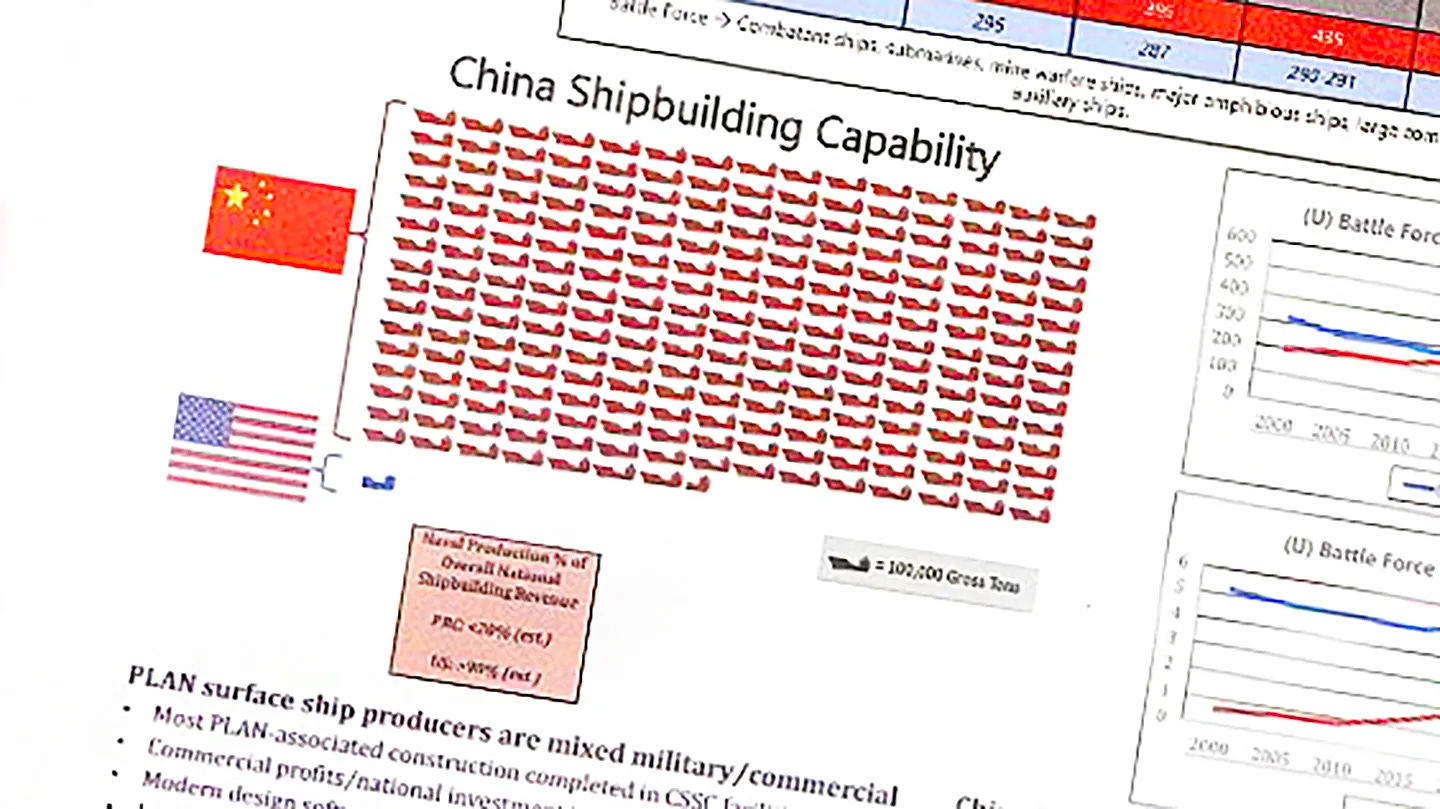
“One Chinese Shipyard can produce more ships in a year than all of ours combined.”
Brigadier General Mark Clingan, USMC, 2023.
“China has 13 naval shipyards, with one of these facilities having more capacity than all seven US naval shipyards combined.”
Navy Secretary Carlos Del Toro, 2023.
The Office of Naval Intelligence put the disparity in raw shipbuilding capacity at more than 200 to one by tonnage.
America had more than 30 major shipyards in the 1940s. The six that remain today are old, dilapidated, and incapable of closing the gap. Clingan’s diagnosis was that procurement had been “optimized for the 1990s” — in other words, the infamous “peace-dividend” era — and that “our production may not be sufficient for the future conflict.” Which is putting it exceedingly diplomatically. Having divested for years, America can spend as much as it wants, but that will not change the fact that it is completely unable to surge to meet the demands of the future the way it has in the past.
One of the National Security Desk’s iron laws of international affairs is that a peace dividend always becomes a yawning war deficit in a much shorter period than anyone anticipates. There is never the opportunity to gradually rebuild. The cost of rapid reconstitution to face the next threat is always multiples of what was lost.
The comforting American myth that the nation can simply reactivate its World War II “arsenal of democracy” surge model is mathematically impossible. (For a comprehensive diagnostic on this structural collapse, see NSD’s companion briefing: The Sunk Fleet).
The consequences of this systemic atrophy are already manifest in the “ready” fleet. The USN is suffering chronic maintenance bottlenecks and backlogs. Nuclear carriers and submarines are maintained at just four public shipyards — Norfolk, Portsmouth, Puget Sound, and Pearl Harbor — most of their dry docks dating to the Second World War or earlier, now in the middle of a twenty-year program to rebuild infrastructure that should never have been allowed to decay. The result is a fleet that spends its life waiting for a berth. The Congressional Budget Office found in December 2025 that maintenance on the Navy’s conventional warships routinely runs twenty to a hundred percent longer than scheduled, and that an Arleigh Burke destroyer — two-thirds of the surface combatant fleet — will spend an average of nine years out of service for maintenance, more than a quarter of its life and twice what was planned. A warship that exists but sits in a dry dock waiting for a yard is, to the fleet that needs it, a warship that is as good as sunk.
Under the 'Rule of Three,' this limited inventory translates to just 100 ships actively available for global operations at any given time. The ships at sea tonight face a severe personnel crisis. In late 2025, the Navy reported 20,683 unfilled at-sea billets—a staggering shortfall for a fleet of fewer than 300 ships. While the Navy states it requires a 381-ship battle force to meet national security demands, expanding the fleet by nearly a third is a massive logistical hurdle: every additional hull must be crewed from an already strained recruiting base.19
Nor can the fleet be rearmed at the rate it fights. The United States entered Operation Epic Fury with roughly 3,100 Tomahawk cruise missiles and fired more than 1,000 at Iran — about a third of the entire inventory. Tomahawk procurement has averaged 86 missiles a year over the past decade and runs below 200 a year now following costly rushed orders; nearly 800 of the remaining 2,000 Tomahawks are owed to Japan, Australia, and the Netherlands. Of some 2,500 Patriot interceptors, between 1,060 and 1,430 were expended, and none of these stocks returns to pre-war levels before 2029. Again Taiwan pays the price. The United States paused arms transfers to Taiwan to conserve munitions for the Iran campaign, with the acting Navy Secretary telling the Senate in May 2026 that the pause was to keep “the munitions we need for Epic Fury.” In a supreme tragicomedy of backward logic, the magazine built to deter China has been squandered on an Iranian campaign that failed to secure its uranium, failed to change the regime, and ultimately achieved the exact opposite of what it intended: a locked Strait of Hormuz.
Worse still, the platforms carrying the largest share of that magazine are leaving the service. Just 4 Ohio-class guided-missile submarines (SSGN) match the combined vertical magazine of all 47 fast-attack submarines remaining in the fleet. These formidable platforms will retire between 2026 and 2028 with no comparable replacement. To replicate the submerged strike density of just one retiring Ohio, the Navy will have to task thirteen standard attack submarines to do the work of one. Considering the Navy only has roughly 15 to 18 fast-attack submarines deployed at sea globally on any given day, replacing the firepower of a single retiring SSGN would require exhausting nearly the entire active undersea fleet worldwide. This fractures American undersea power at the exact moment the missile inventory itself runs dry.
Yet this depletion is merely the prelude to a far greater crisis in the Pacific. Iran was the lesser case. CSIS war-gamed a Chinese invasion of Taiwan two dozen times and found the United States would expend up to 5,000 long-range precision missiles in three weeks of fighting — running America’s entire inventory of long-range anti-ship missiles dry within the first week, and most of its JASSM stock by the ninth day. That war game was conducted before the war in Iran drained all those missiles stocks to achieve the economic strangulation of the world.
Crucially, CSIS baseline simulations assumed a pristine, full magazine. That magazine no longer exists, because a significant portion of it has been spent against Iran. Of the estimated 5,000 missiles needed, more than 150 THAAD interceptors were fired against Iranian ballistic missiles. Not one new THAAD interceptor will be delivered to the United States between 2023 and 2027. The SM-3 — the only interceptor that kills a ballistic missile in space — stands at roughly 150 on hand, and takes thirty-six to thirty-nine months to replace. The thousand-plus Tomahawks, the eleven hundred JASSMs, the entire Precision Strike Missile inventory, the interceptors — all of it came out of the same stock the Pacific plan was counting on, and for four of the seven munitions that decide such a war, more than half the pre-war inventory may already be gone. What the war game said the United States would need in the first three weeks against China, it has largely spent against Iran. The arsenal already judged too shallow for a peer fight is now the depleted remainder of a regional one.
And nothing returns quickly. The JASSM-ER fired at Iran replaces at about 396 a year, so rebuilding the roughly 1,875 expended or committed takes nearly five years — and only if the line builds no LRASM at all, since the two share it. The Tomahawks come back at under 200 a year against more than a thousand fired. The THAAD inventory draws down across eight active batteries, with no new interceptors delivered between 2023 and 2027. The SM-3 takes thirty-six to thirty-nine months a round. Every magazine the Iran war drained refills on a clock measured in years, while the war it was drained to deter would be spent in days.20
Iran cost a third of the Tomahawk magazine against a regional power. The war the United States claims to be deterring would empty the decisive magazines in days — against an adversary whose missiles are counted in the thousands, stored beyond our reach, while ours sit within range of his on Guam, an island that, for all practical purposes, remains undefended: a single THAAD battery, terminal and ballistic-only, against the hundreds of land- and sea-launched missiles ranged on it, a threat known and unhedged for over a decade.21 INDOPACOM’s own commander testified that his forces — the ones that exist to deter China — were “indispensable” to the war against Iran. The magazine built to deter the greater threat was spent deterring the lesser one.
Against those few hundred American interceptors stands the arsenal they exist to stop.
China fields:
More than 1,000 short-range ballistic missiles;
1,300 medium-range ballistic missiles;
550 intermediate-range missiles — the DF-26, ranged to reach Guam;
400 intercontinental missiles.
China boasts the largest land-based missile force on Earth, with several hundred more in North Korea behind it — and it is built on the same industrial base that already out-produces American shipyards two hundred to one. China has been building and accumulating its war stocks for two decades of complete peace guaranteed by the US. The Pentagon’s own estimate of China’s nuclear warheads has been revised upward with almost every report — surpassing 400 in 2022, crossing 500 in 2023, and climbing past 600 through 2024 — shattering a 2021 projection that didn’t expect a push toward 700 until late in the decade.
There is little reason to assume the US count of Chinese conventional munitions is any more accurate.22 Washington made the same comfortable assumptions about Iran, only to be blindsided by a nation with double the expected missile range and three times the assumed magazine depth—failures the National Security Desk mathematically mapped and published days before the Intelligence Community caught up to reality.
But even if the Pentagon's baseline numbers on China are perfectly accurate, the strategic math is already broken. The opening salvo of a Pacific war will not be a contested battle; it will be an unmitigated slaughter, because the paper inventory overstates what could actually be fired for two systemic reasons the budget numbers deliberately conceal:
The Forward Magazine is a Sitting Target: The ammunition required for a Pacific war is held almost entirely at Guam and in Japan—both trapped deep inside the ring of Chinese precision missiles they are meant to stop. The DF-26 is known as the “Guam killer” for a reason. Under the unyielding geometry of Chinese interior lines, a devastating share of the American arsenal will be vaporized on the tarmac and in vulnerable above-ground bunkers in the opening minutes of a conflict, before a single vertical-launch cell can even cycle.
The Reload Trap is a Death Sentence: A warship fights solely with the missiles already loaded into its launch cells—leaving it with an effective combat life measured in hours. Because the Navy cannot reload at sea, a depleted surface combatant is functionally useless. To rearm, a multi-billion-dollar destroyer must turn its back on the fight and steam directly back into the primary target zone—Guam or Japan—to queue at fixed, exposed piers that will almost certainly already be cratered. The reload cycle doesn’t sustain the fleet; it forces American crews to choose between remaining in theater defenseless or sailing back into a pre-registered kill zone. The obvious question is why isn’t the US quadrupling its ludicrously light initial investment in Australian munitions manufacturing under Pillar II of AUKUS? Australia has the industrial base, strategic depth, and proximity to the region to really count in a shooting war.
China’s victims will not discover the true, likely much higher number until they are met on the field of battle.
In summary: China’s magazine is full. Beijing has enjoyed the luxury building its extraordinary arsenal for two decades in complete peace delivered by the US, ensuring it has never had to shoot a single missile in anger. Washington, by contrast has squandered a third of its cruise missiles and the core of its long-range strike stock on the latest self-defeating mid-eastern folly fully knowing the rebuild clock is measured in years. China’s missile stocks are locked and loaded at scale. Their production lines continue to pump out weapons backed by an industrial base that out-produces American shipyards two hundred to one. Chinese factories are no further than a truck delivery from the front. America’s resupply is forged a hemisphere away, runs years behind schedule, and must cross the expanse of the Pacific—directly through contested waters—to arrive at all. The arsenal built to deter the superpower has been spent deterring the proxy, and what little remains cannot be replaced before the very war it was meant to prevent is already decided.
General Douglas MacArthur warned America of the costs of strategic malpractice a long time ago:
“The history of failure in war can almost be summed up in two words: Too late. Too late in comprehending the deadly purpose of a potential enemy. Too late in realizing the mortal danger. Too late in preparedness. Too late in uniting all possible forces for resistance.”
The Hammer and the Anvil
“China is a big country and other countries are small countries, and that’s just a fact.”
Foreign Minister Yang Jiechi ASEAN Regional Forum Hanoi July 2010.
Yang had grown annoyed with several Southeast Asian foreign ministers voicing concern over China's growing assertiveness — conquering atolls and building sea forts, completely unchallenged by Washington. The tension between the two sides came down to how each read America. All understood that America was squandering its strength in the Middle Eastern sandpit. Having shipped its Pacific forces off to chase bandits leaving skeletons behind. Washington's material commitment to the Indopacific grew ever more threadbare even as its rhetorical commitment escalated to embarrassing proportions. To any astute observer, the hyperactive messaging was itself the tell — an immediate indicator of weakness. Yang could see straight through the empty tubes; he was merely frustrated that the ASEAN members could not.23
The volume and frequency of reassurances rose over the decade of borrowing from Asia to pay the mideast. Uniformed commanders worked the circuit: Admiral Willard, US Pacific Commander, surfacing in Manila, then the DC think-tank podiums, then the White House briefing room, each appearance pledging America’s commitment to regional security while the carriers stayed home. The Secretary of State (re)declared “America’s Pacific Century.” The President assured an anxious Australian Parliament that the United States was “here to stay” — a line the Secretary of State would recycle word-for-word in Perth a year later. The words simply kept coming, and each fresh communiqué bought Washington nothing but the sound of its own voice — the volume rising precisely as the substance thinned.
True hegemons do not run PR campaigns to remind the world they exist. For half a century America’s primacy was the unspoken baseline of the international order; the Seventh Fleet did the talking because everyone could see its big stick. So the sudden, anxious compulsion to recommit was itself the anomaly — and the sheer volume of reassurance became the truest metric of decline. As the shipyards idled and the fleet shrank, a new vocabulary emerged to paper over the deficit: white papers, freshly minted acronyms, podium-pounding declarations of “unwavering resolve.” It was the diplomatic equivalent of whistling past the graveyard. You do not proclaim you are “here to stay” unless you already have one foot out the door.
What Washington’s speechwriters never grasped was that the allies were listening not to what was said, but to the fact that it had to be said at all. Throughout the Cold War and the unipolar decade that followed, American power in the Pacific was an assumed reality; its sudden conversion into a talking point was the message. The rhetoric escalated precisely because the material reality was moving the other way - our Asian allies could observe US forces removed from their soil and being sent away — the necessity of the reassurance betrayed the retreat. By insisting so loudly that it was not leaving, Washington handed Beijing, and ASEAN, the clearest possible evidence that it already had.
Soon Washington announced its famous “pivot” to Asia. It was pure rhetorical stagecraft devoid of any substance whatsoever. Not one carrier or attack submarine moved to the Pacific — an accounting exercise dressed as a pivot. Kurt Campbell — the man who would later title his book The Pivot — brokered the deal meant to end the standoff at Scarborough Shoal, well inside Philippine waters: Manila and Beijing would withdraw together. On 15 June 2012 the Philippines pulled its ships out. Beijing reneged, kept its own in place, and holds the shoal to this day. In a replay of the Budapest memorandum bait and switch that has undergirded Russia’s invasion of Ukraine, Washington, having talked its treaty ally into retreat, did nothing to reverse it. The pivot’s first live test was a strategic node seized inside an ally’s own exclusive economic zone — surrendered while the rhetoric of commitment was at its loudest. Campbell’s own treatise would later dispose of the episode in a single sentence. America should have used force to fulfill its promise or not made the promise at all. China is skilled enough to call a bluff.
America never slowed the tsunami of empty words. The adjective “ironclad” — a word no president had applied to an American guarantee before Reagan reached for it in 1982 — was bolted to every alliance and repeated until it corroded into noise. In 2018 the entire combatant command was rechristened from “Asia-Pacific” to “Indopacific,” a renaming its own architects conceded was symbolic, moving not a single ship or soldier to match it. Fifteen years on, the divergence had grown so wide that even Washington’s own commentariat had taken to describing those ironclad commitments as rusting.
The balance of forces did not match the words then, and it never will again. China commands approximately 300–550 'Guam Killer' missiles, to say nothing of the hundreds of additional sea- and air-launched variants available to the PLAN. The target for this massive concentration of firepower is a single, heavily concentrated footprint of American Pacific power. On this lone island sits the only submarine base in the Western Pacific where American boats can rearm in-theater, the only forward bomber base for regional B-52 stages, and the primary munitions reserve outside Japan or Hawaii. Against a layered, multi-axis salvo a decade in the making—Sea Fort Alamo is defended by a single THAAD battery: six launchers, roughly four dozen interceptors, terminal and ballistic-only, saturable in one salvo and blind to the cruise missiles entirely. America is not even pretending to take China seriously. It no longer possesses the military capacity, the national budget, or — most importantly — the political will to defend its own territories let alone its allies.
As Washington’s capability continues to shrink while Beijing’s shadow expands, the democratic states of Asia find themselves trapped in a terrifying geopolitical vice. American weakness has become the passive, unyielding anvil—and China is the hammer, ready to strike.
China is already wielding that hammer unanswered by Washington—ramming Philippine cutters, driving fighters and bombers across the Taiwan centerline, pushing patrols into Japanese waters, and dangling commodity and economic restrictions over anyone who hesitates. American abandonment is the anvil. But a hammer and an anvil do not only crush what lies between them; together, they forge it. The metal China is beating is the very coalition of states that hold its gates, and every blow work-hardens that raw material into the one configuration Beijing cannot afford: a regional bloc with the motive to close the straits and, increasingly, the means.
This product is already taking shape, an unintended consequence of the totalitarian blacksmith: entrepreneurial military diplomacy is breaking out among former US allies on both flanks of Eurasia. Driven by a shared realization of Washington's structural decay, these states are moving defensively.
In Europe, Macron is extending France’s nuclear deterrence framework to states the American umbrella once covered—a paradigm shift that saw Norway become the ninth nation to join.
In Asia, middle powers and archipelagic states are self organizing for their own defense outside of Washington’s empty promises. Japan is quietly shedding its limits on long-range strike, lifting its ban on arms exports, and leading a whirlwind of diplomacy building a new coalition of necessity. South Korea, setting aside a century of deep suspicion toward Tokyo, has announced its intent to build an indigenous nuclear-powered submarine—a capability Japan has signaled its own interest in pursuing. Australia has emerged as the first eager customer for Japanese frigates, while fast-tracking sovereign autonomous platforms that Tokyo and Seoul will not be able to ignore.
The Iran example has shown the coalition of necessity the future. With control of a single geographic chokepoint, Tehran reached past the mass of the United States military and laid its hand directly on American inflation, six months out from a consequential election—without winning a single fleet battle, and without holding to a single deal, simply by sitting astride the Strait of Hormuz.
The Gates to Freedom
Iran spent a generation and a ruined economy chasing a nuclear weapon it could never realistically use, only to discover it already held something much more powerful: a gate. Sitting on Hormuz gave Tehran the coercive reach of an atom bomb with none of the escalatory costs of detonation. Between China and the global economy there are ten gates—and the states that sit astride them have spent a decade being rammed, buzzed, and bullied by the very power whose jugular they hold within their territory. The National Security Desk urges the coalition of necessity to recognize what it already holds: a weapon more potent than an atom bomb. The Philippines and Indonesia are nuclear-scale powers in the only currency that matters against a maritime empire: the power to shut the gate to the outside world.
The democracies in Asia, despite their modest military capabilities, can come together and defend themselves against the autocracies. They can turn China’s A2AD back on itself. China can deny the South China Sea to the United States; the democratic coalition of necessity can deny the world to China. One is catastrophic; the other, existential. This counter A2AD strategy, combined with nuclear proliferation to key allied powers, will checkmate China in the region and ensure its adherence to international rules and norms. No other strategy presents itself.
This is the “reverse A2AD” (Anti-Access/Area Denial) regime that the National Security Desk has advocated for years. It is not a wall of American mass returning to a theater it abandoned, but a distributed denial network built directly on and around the gates of the first and second island chains—archipelagic geography married to middle-power strike. Defeating China under this model does not require matching its raw tonnage; it merely requires threatening its arteries.
The hammer is still falling—but between hammer and anvil, the region is being forged into a blade, and that blade is turning toward the blacksmith's jugular. A natural alliance of strategic necessity is taking shape across the region—spanning Australia, Japan, India, Indonesia, the Philippines, and the smaller archipelagic states whose waters command China's seaborne lifelines. They already hold the weapon. How they use it is the subject of the next assessment in the Third Offset Strategy.
Eighty years ago, the democracies left Yalta believing they had no choice but to surrender half of Europe to a tyrant, only for the suppressed people of that very deal to eventually rise up and bring down the Soviet empire. If the Beijing summit was the moment the new autocrats ratified America's default, they have inadvertently set the same historical clock in motion. The hinge of history is swinging once again—and this time, it is the blacksmith’s own jugular that lies exposed to the blade.
The National Security Desk offers these posts freely, but your support is necessary and appreciated. Please subscribe, paid if you’re able, or leave a tip.
Sovericide occurs when the central authority abandons constitutional constraints, repurposes state power against the polity it governs, and initiates actions that erode or dismantle the institutional, legal, and geopolitical foundations of the state. Unlike coups, revolutions, or foreign invasions, sovericide is endogenous: the sovereign kills itself. In practice, sovericide becomes visible when constitutional norms are systematically abandoned, when the executive consolidates effective control over all branches of government, and when state instruments are redirected against domestic political opponents. It advances as the sovereign realigns national strategy away from historic interests and toward personal or factional imperatives, and it accelerates when internal collapse proceeds without external compulsion. These dynamics, taken together, mark the transition from authoritarian consolidation to sovereign self-termination.
The NSD takes no pleasure in highlighting American weakness. Yet national pride cannot substitute for political, economic and military failures. These have to be honestly assessed and accounted for in strategic analysis in order to adequately prepare for what is coming. Holding on to fairytales of American power and will is a road to ruin for America and those states it has spent the last decade robustly rejecting as allies.
China may lack the ability to fight as a joint force, seamless technological and managerial integration of its kill chain, a professional NCO corps, no mission command philosophy due to party-driven hierarchical control and the absence of allied support. The problem is we will not know for sure if these deficits exist and how serious they are until the shooting starts. China, following the dictates of Sun Tzu has already out maneuvered the US to not even dare fighting inside the first island chain. The second and third are in doubt too as China’s missile stocks grow unchallenged.
This quote has been reordered in order to assist readers to understand the full impact of Xi’s statement. Chinese diplomatic rhetoric is designed to land punches without the victim understanding what has happened until they get home and talk to their experts. This is precisely what happened here as witness by Trump spinning Xi’s warning as a criticism of the Biden Administration (what else?). He went on to brazenly lie that Xi praised Trump because thats what Trump craves and never receives. All of this totally misses the point of what Xi was really saying - hence the reordering of the words of the quote to make it crystal clear.
The Putin regime's self-inflicted ledger: roughly 1.2 million casualties, as many as 325,000 dead — losses no major power has absorbed in any war since 1945. A first-quarter 2026 federal deficit of 4.6 trillion rubles (~$59 billion), already past the entire year's target in three months, as oil-and-gas revenue fell 45 percent. Up to 40 percent of oil-export capacity knocked offline by Ukrainian drones, with a fuel crisis now biting inside Russia itself. A war economy braced on a key rate that touched 21 percent, 2 percent unemployment, and a labor shortage the central bank calls unprecedented in modern Russian history. Liquid National Wealth Fund reserves drawn down to roughly $52 billion — less than half their pre-war level. 547 Western firms gone, the engineers and programmers gone with them, and growth flatlined near 1 percent; the Victory Day parade shrunk to fit beneath a drone threat its air defenses cannot lift. Russia did not lose this to a peer. It gave it away on a breathtaking miscalculation.
Yalta endures as a hinge point in history precisely because three forces — values, national interest, and military reality — all pointed in different directions simultaneously, and no single leader could satisfy all three. Churchill understood the values cost most acutely: Britain had gone to war in 1939 for the explicit purpose of defending Polish sovereignty, and he now sat at a table ratifying its surrender to a Soviet-installed regime — a moral betrayal written into the peace that the war had been fought to prevent. FDR sacrificed those values for what he calculated was the greater national interest: Soviet entry into the Pacific war, Soviet participation in the new United Nations, and the construction of a bipolar great-power order in which Washington and Moscow, not London, would manage the world — a calculation that required treating Eastern Europe as acceptable coin. Stalin had no values constraint whatsoever and simply harvested the military reality, securing the buffer states that Russian strategic doctrine had always demanded as the price of national survival. That military reality, it must be said, was not yet the total Soviet fait accompli it would later appear — the balance of forces in May 1945 was genuine, with Western armor and air power a credible counterweight — but the democratic imperative to demobilize meant the West could not hold that posture, and Yalta’s agreements gave Western governments the political legitimacy to stand their forces down without formally surrendering all of Europe. The deepest tragedy is not that any one leader was uniquely villainous or naive — it’s that the democratic system that won the war structurally could not sustain the military posture required to enforce its own stated values at the moment of victory; and when the Soviets tested that nuclear guarantee in 1953, the Western deterrent that replaced armies made clear just how thin the margin between the settlement and catastrophe had always been.
As always happens after the short term peace dividend, a sudden new set of demands caused all of those benefits to be reversed in short order. Germany had to be resurrected as a military and economic power. However, for a variety of cultural reasons, that process is only now bearing strategic weight. In Asia, the same is true of Japan.
Polish scientists had given so much to saving the world from tyranny by gaining access to, and breaking, the enigma machine. When the chips were down they sacrificed their one strategic advantage by simply giving it away to Britain. Sir Harry Hinsley, a veteran Bletchley Park cryptanalyst and the official historian of British Intelligence in WWII, explicitly credited the Polish Cipher Bureau with laying the indispensable foundation for the entire Allied codebreaking operation. He noted that the Polish mathematicians' breakthrough—notably reconstructing the exact wiring of the military Enigma machine and inventing the mechanical "Bomba" codebreaking machine—was handed over to the British "in the nick of time" just five weeks before the 1939 invasion of Poland. Because Hinsley famously estimated that breaking the German codes ultimately shortened the war in Europe by two to four years, his official assessment directly attributes this multi-year acceleration of the Allied victory to the groundwork laid entirely by Poland.
The Polish squadrons—most famously No. 303 Squadron—played a massive, arguably decisive role in the Battle of Britain during the summer and autumn of 1940. Despite entering the conflict only on August 31, 303 Squadron became the highest-scoring RAF unit of the Battle of Britain, destroying 126 German aircraft in just six weeks. Composed of battle-hardened veterans (constituting just 5% of the Allied pilot force) the Poles accounted for nearly 8% of all Luftwaffe losses during the battle, their efficiency and high success rate led Air Chief Marshal Sir Hugh Dowding to state that the outcome of the battle would not have been the same without them.
In short, under the One China policy the U.S. and others acknowledge Beijing’s claim that Taiwan is part of China without endorsing it, take no position on the island’s final status, and insist only that any resolution be peaceful and reached with the consent of Taiwan’s people — not imposed by force.
The implication being that this invasion and occupation should have been militarily deterred and, if necessary, repulsed by the United States. This has always been the position of the National Security Desk. The PLA of the 1990s and early 2000s was a completely different animal to what is has become. America’s greatest strategic failure over that period was not holding the line. We resisted the invasion of Kuwait. We allowed the invasion of these reefs and their transformation into armed islands. These are not Chinese territory. Their sovereignty is contested among a number of SE Asia nations who alone could not militarily resist Chinese power at that time. As will be argued in this assessment, America continues to confuse urgency with importance in its assessments and commitments to Middle East vice Asia. A superpower should be able to manage both. In theory the US military was structured to simultaneously fight two major regional wars. The reality is that capability and capacity eroded long ago.
See Eve Sampson, “Iran war may force US to shift missile defenses from South Korea, Seoul says,” Defense News, March 11, 2026; and “U.S. Begins Withdrawing THAAD Missile Defence Systems From South Korea to Replenish Losses in War with Iran,” Military Watch Magazine, March 10, 2026, cross-referencing The Washington Post reporting on C-17 logistical flights out of Osan Air Base. For data on the strategic depletion of the ~600 global THAAD interceptor stockpile during Operation Midnight Hammer and subsequent 2026 operations, see JINSA Policy Report, “U.S. Interceptors Are Depleted,” January 30, 2026, and The Jerusalem Post, March 4, 2026 (detailing the 2025 deployment of South Korea-based Patriot batteries to Al Udeid). Strategic impact and launcher containment are confirmed in the March 9, 2026 Cabinet Address by ROK President Lee Jae-myung (via Yonhap News Agency) and the Congressional posture testimony of Gen. Xavier T. Brunson, Commander of USFK, before the House Armed Services Committee, April 22, 2026.
US trade with Iraq and Afghanistan in 2024 was $12 billion. Strip out Iraqi oil, which the United States would have bought regardless of the war, and the genuine commercial relationship collapses to $71 million. Based on 2026 estimates from the United Nations, the combined population of Afghanistan and Iraq is approximately 93.7 million. The combined population of ASEAN, Japan, South Korea, Australia, and Taiwan is ~919 million people.
U.S. Naval Institute. (2026). USNI News fleet and marine tracker. USNI News. https://news.usni.org/category/fleet-tracker Public data from open-source intelligence and official tracking (such as the USNI News Fleet and Marine Tracker) confirms that the U.S. Navy’s real-world footprint mirrors the theoretical rule almost perfectly. On any given day, the U.S. Navy maintains approximately 100 ships deployed or at sea globally (typically fluctuating between 95 and 105 depending on the exact week). Despite heightened operational tempos in regions like the Indo-Pacific and the Middle East, the steady-state baseline remains anchored to this number.
For a comprehensive analysis of expenditure data and production timelines, see “Last Rounds? Status of Key Munitions at the Iran War Ceasefire,” Center for Strategic and International Studies (CSIS), April 2026; and Congressional Research Service, Terminal High Altitude Area Defense (THAAD), CRS Report (Washington, DC: Library of Congress, 2025). Production lead times and replenishment rates are derived from the Office of the Under Secretary of Defense (Comptroller), Defense Budget Materials: Program Acquisition Cost by Weapon System, Fiscal Year 2026/2027. Center for Strategic and International Studies (CSIS). “Last Rounds? Status of Key Munitions at the Iran War Ceasefire.” CSIS Analysis, April 2026. https://www.csis.org/analysis/. Office of the Under Secretary of Defense (Comptroller). Defense Budget Materials. U.S. Department of Defense, 2026. https://comptroller.defense.gov/Budget-Materials/.
Guam has sat within range of China’s conventional ballistic missiles since the DF-26 intermediate-range ballistic missile — nicknamed the “Guam Killer” for precisely this reason — was unveiled at Beijing’s 3 September 2015 victory parade. The threat was formally assessed almost immediately: RAND’s U.S.-China Military Scorecard (2015), the U.S.-China Economic and Security Review Commission staff report China’s Expanding Ability to Conduct Conventional Missile Strikes on Guam (May 2016), and CNAS’s First Strike (2017). The Pentagon’s [2024 China Military Power Report] assesses a DF-26 force of roughly [250 launchers and 500 missiles], a substantial share of which can range Guam, with PLAN surface- and submarine-launched land-attack cruise missiles adding a standoff dimension the island’s defenses cannot address. Against this, Guam’s defense remains a single Army THAAD battery (Task Force Talon, deployed 2013) — six launchers and roughly four dozen ready interceptors, exo-atmospheric, terminal, and ballistic-only — supplemented by episodic Aegis warship coverage. This is point defense fielded originally against North Korea, saturable in a single salvo and blind to the cruise-missile and maneuvering threats that are the entire reason INDOPACOM demanded 360-degree integrated coverage. That system, the Enhanced Integrated Air and Missile Defense (EIAMD) network, received formal go-ahead only in September 2025; first operational elements are not expected before FY2027, full capability not before the early 2030s. As of December 2024, the Government Accountability Office faulted the Department of Defense for still lacking even defined operational requirements for the island’s defense — eleven years after the threat became unmistakable.
U.S. Department of Defense. (2022). Military and security developments involving the People’s Republic of China (Annual Report to Congress). Office of the Secretary of Defense.
For an extensive diagnostic on this specific linguistic compensation pattern—where high-level administrative boilerplate is systematically used to camouflage structural logistical decay and a lack of forward-deployed hardware in theater—see Blake Herzinger and Harrison Prétat, “Washington’s Ironclad Commitments Are Rusting in the Indo-Pacific,” War on the Rocks, September 24, 2025.
Iran and Ukraine have opened our eyes to the possibilities for middle powers. We have been hiding behind the apron of the U.S. because of the belief that we couldn’t protect ourselves. That belief was probably correct twenty years ago. Now, it seems, that that strategy is no longer valid and a better strategy has presented itself. We have the capacity and the capability to protect ourselves collectively and have a ransom at our fingertips to put pressure on a superpower not to take that step. I’m sure China has been looking at Iran and realising the there is a strategic weakness that I don’t think they can fully cover.
At its core, Beijing’s grand strategy is governed by a highly calculated 15-year roadmap designed to fundamentally reorder global geopolitics. This strategy relies on two deeply integrated pillars: domestic ideological consolidation and the massive outward expansion of the Belt and Road Initiative (BRI). This strategy does not seek parity with the West; it seeks a structural replacement.https://triggledger.substack.com/p/china-masters-of-statecraft-and-the?utm_source=share&utm_medium=android&r=8gc1qf








Iran and Ukraine have opened our eyes to the possibilities for middle powers. We have been hiding behind the apron of the U.S. because of the belief that we couldn’t protect ourselves. That belief was probably correct twenty years ago. Now, it seems, that that strategy is no longer valid and a better strategy has presented itself. We have the capacity and the capability to protect ourselves collectively and have a ransom at our fingertips to put pressure on a superpower not to take that step. I’m sure China has been looking at Iran and realising the there is a strategic weakness that I don’t think they can fully cover.
Interesting times!
At its core, Beijing’s grand strategy is governed by a highly calculated 15-year roadmap designed to fundamentally reorder global geopolitics. This strategy relies on two deeply integrated pillars: domestic ideological consolidation and the massive outward expansion of the Belt and Road Initiative (BRI). This strategy does not seek parity with the West; it seeks a structural replacement.https://triggledger.substack.com/p/china-masters-of-statecraft-and-the?utm_source=share&utm_medium=android&r=8gc1qf